Zero Forex Markup Credit Card in India: What It Saves and What It Doesn’t
What a forex mark-up costs on Indian credit cards, and how Scapia (0%), BOBCARD Etihad Guest (1%) and Tata Neu Infinity (2%) compare, from bank pages.
Looking for a zero forex markup credit card in India before your next trip abroad? The mark-up is the small percentage your bank adds to every payment made in a foreign currency, or to a merchant based outside India. It rarely shows up as a separate line you notice, so most people only see it when they add up the trip later.
We read the official pages of the three cards on our credit cards page that publish a mark-up figure: Federal Bank’s Key Fact Sheet for the Scapia card plus Scapia’s own pages, BOBCARD’s Etihad Guest page, and HDFC Bank’s Tata Neu Infinity page, card FAQ and MITC. All were read on 12 Nov 2026 (see Sources). Every fee and rate below comes from those pages. Other cards appear only as plain text. For the lounge side of the same cards, see our credit cards with lounge access guide.
Quick answer
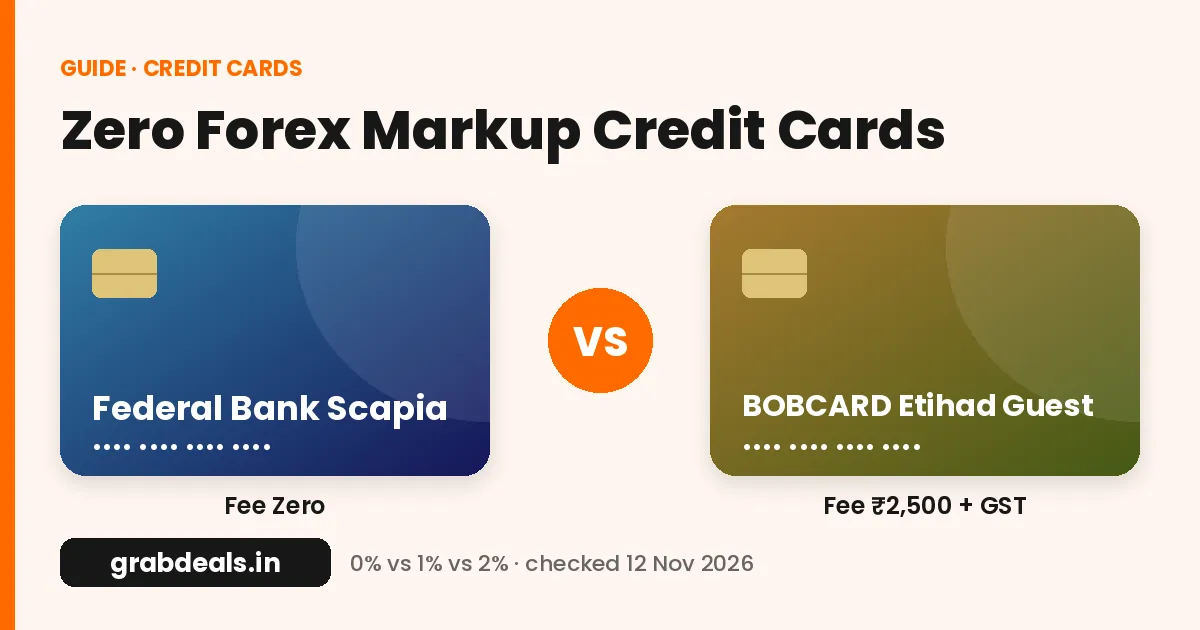
Among the cards on GrabDeals, only the Federal Bank Scapia card lists a 0% forex mark-up (with Nil joining and annual fee, as per its Key Fact Sheet read on 12 Nov 2026). BOBCARD Etihad Guest lists 1% and adds international lounge visits for a ₹2,500 + GST fee. Tata Neu Infinity HDFC lists 2%. On ₹1,00,000 spent abroad, that is ₹0 vs ₹1,000 vs ₹2,000 in mark-up, before GST. Approval and terms are decided by the bank; this is information, not financial advice.
Federal Bank Scapia Credit Card
Federal Bank × Scapia
0% (Nil) foreign currency mark-up, Nil joining and Nil annual fee, per Federal Bank’s Key Fact Sheet (v11, 30 Apr 2026)
- Joining fee
- Zero
- Annual fee
- Nil (Federal Bank KFS v11)
- Forex markup
- 0% (Nil)
Best for: Zero mark-up abroad with no annual fee. Federal Bank decides approval and limit.
Apply NowApproval, limit and final terms are decided by the bank.
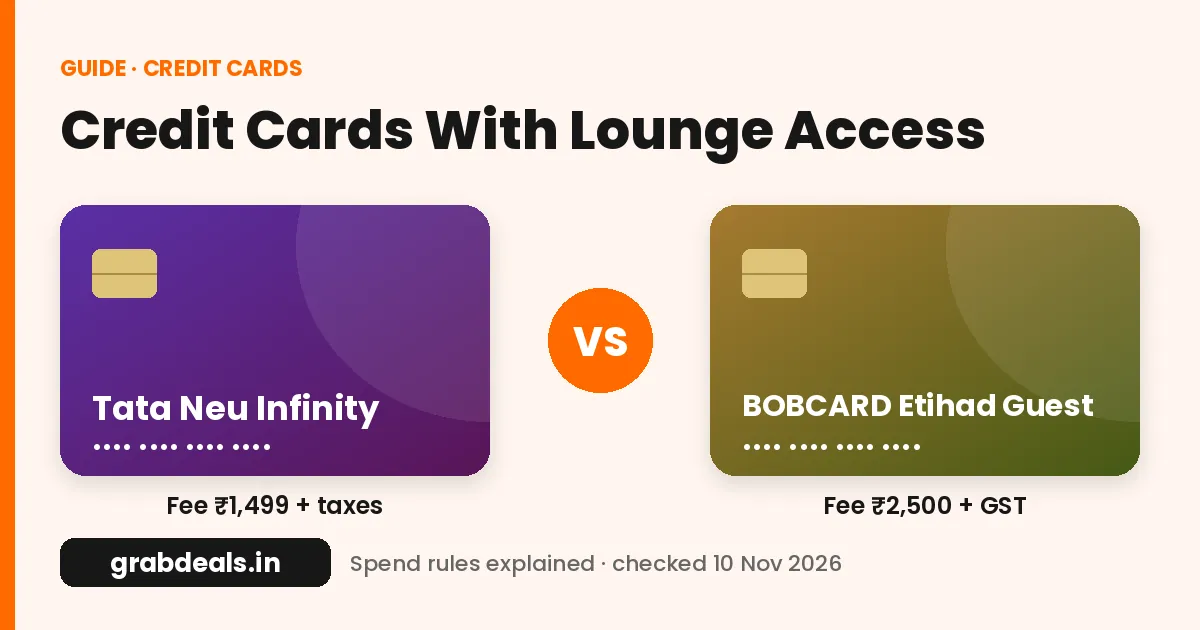
BOBCARD Etihad Guest Credit Card
BOBCARD (Bank of Baroda)
1% forex mark-up, plus 4 international and 8 domestic lounge visits a year, per BOBCARD’s product page
- Joining fee
- ₹2,500 + GST
- Annual fee
- ₹2,500 + GST (waived on ₹3,00,000+ spend in each anniversary year)
- Forex markup
- 1%
Best for: Frequent international flyers who also want lounges and Etihad Guest Miles. BOBCARD decides approval and terms.
Apply NowApproval, limit and final terms are decided by the bank.
Tata Neu Infinity HDFC Bank Credit Card
HDFC Bank × Tata Neu
2% FCY mark-up on transactions outside India (HDFC Bank card FAQ), with 4 international lounge visits a year
- Joining fee
- ₹1,499 + taxes
- Annual fee
- ₹1,499 + taxes (renewal waived on ₹3,00,000+ spend)
- Forex markup
- 2% (HDFC Bank card FAQ)
Best for: Tata Neu shoppers who travel abroad now and then. HDFC Bank decides approval and terms.
Apply NowApproval, limit and final terms are decided by the bank.
What a forex mark-up actually costs you
When you pay in dollars, euros or dirhams, the card network converts the amount to rupees and your bank then adds its mark-up on top. HDFC Bank’s MITC, for example, lists 3.5% on several of its own cards (such as Regalia First and PhonePe HDFC Bank Ultimo) and 2% on Infinia, while its Tata Neu Infinity FAQ lists 2%. Federal Bank’s KFS adds that GST applies on all fees and charges. So the same ₹1,00,000 trip can cost very different amounts depending on the card in your wallet.
| Spend abroad | 0% mark-up | 1% mark-up | 2% mark-up | 3.5% mark-up |
|---|---|---|---|---|
| ₹25,000 | ₹0 | ₹250 | ₹500 | ₹875 |
| ₹1,00,000 | ₹0 | ₹1,000 | ₹2,000 | ₹3,500 |
| ₹3,00,000 | ₹0 | ₹3,000 | ₹6,000 | ₹10,500 |
These are simple percentages of the spend, before GST on the fee. The exchange rate itself is set by the network on the settlement date (HDFC Bank’s MITC says this too), so even a 0% card won’t match the rate you see on Google exactly.
Forex mark-up compared: Scapia, BOBCARD Etihad and Tata Neu Infinity
| Card | Forex mark-up | Joining / annual fee | Fee waiver | Abroad extras (bank page) |
|---|---|---|---|---|
| Federal Bank Scapia | 0% (Nil) | Nil / Nil | Not needed | No international lounge; up to ₹2,000 back at international terminals in India on a qualifying Scapia flight booking |
| BOBCARD Etihad Guest | 1% | ₹2,500 + GST | ₹3,00,000+ spend in each anniversary year | 4 international + 8 domestic lounge visits a year; Etihad Guest Miles |
| Tata Neu Infinity HDFC | 2% | ₹1,499 + taxes | ₹3,00,000+ spend in a year before renewal | 4 international lounge visits a year (1 a quarter), outside India |
Our other listed cards, Tata Neu Plus HDFC and YES BANK POP-CLUB, don’t show a mark-up figure on the card pages we read, so we have left them out of this comparison rather than guess.
Federal Bank Scapia: the only 0% card on our list
Federal Bank’s Key Fact Sheet (version 11, dated 30 Apr 2026) lists Foreign Currency Mark-up: 0% (Nil), Joining Fees: Nil and Annual Membership Fees: Nil. Scapia’s homepage repeats “Zero forex markup on all spends abroad” and notes that its Smartforex feature works only with the Visa card. You get two cards on one limit, a Visa and a RuPay, so carry the Visa card for overseas payments.
Rewards and the fine print
Scapia’s card explainer lists 10% Scapia Coins on eligible Visa spends, 5% on eligible RuPay/UPI spends of ₹500 or more, and 20% on bookings made in the Scapia app, at a fixed 5 coins = ₹1. That same page lists “Forex transactions” among spends that earn no coins, so don’t count on rewards from your overseas swipes. Check the app for how a given foreign spend is treated.
The zero mark-up doesn’t make everything free. The KFS lists a cash advance fee of 2.5% of the amount or ₹500, whichever is higher, and interest of 45% a year (3.75% a month) on revolving credit and cash. Pay with the card abroad, and avoid ATM withdrawals on it. Read our full Scapia credit card review for the rest. Apply Now
BOBCARD Etihad Guest: 1% mark-up with lounges abroad
BOBCARD’s product page lists a 1% forex mark-up and a joining and annual fee of ₹2,500 + GST, charged at issuance and non-refundable. The annual fee is waived on spends of ₹3,00,000 or more in each card anniversary year. Age eligibility on the page is 21–60 years, for Indian residents, salaried or self-employed.
What you get for the fee: 4 international (1 per quarter) and 8 domestic (2 per quarter) lounge visits a year, 3 Etihad Guest Miles per ₹100 on Etihad Airways and 1 Mile per ₹100 on other domestic and cross-border spends. The page also lists 7,500 bonus Miles as a welcome benefit: 5,000 on ₹25,000 spend in the first 65 days with the joining fee paid, plus 2,500 on cumulative spends of ₹50,000. Miles are redeemable only on the Etihad platform.
At 1%, a ₹1,00,000 trip costs ₹1,000 in mark-up. Whether the fee pays off depends on how much you value the lounges and Miles, not on the mark-up alone. Apply Now
Tata Neu Infinity HDFC: 2% mark-up, useful if you already use Tata Neu
HDFC Bank’s Tata Neu Infinity FAQ says the card has a 2% FCY mark-up on any transaction made outside India. The joining/renewal fee is ₹1,499 + applicable taxes, and the renewal fee is waived on ₹3,00,000 or more spend in a year before the renewal date. The welcome benefit is 1,499 NeuCoins on your first transaction within 30 days of issuance.
For travel, the card lists 4 complimentary international lounge visits a year (1 per quarter) outside India. On the Visa variant, Priority Pass has been issued only on request since 1 June 2025. Eligibility on the bank page: salaried, age 21–60 with ₹1,00,000 monthly income; self-employed, age 21–65 with annual ITR above ₹12,00,000.
The 2% mark-up makes it a weaker pick purely for spending abroad. It makes sense if Tata Neu rewards are your main reason and foreign trips are occasional. Our Tata Neu Plus vs Infinity guide covers the shopping side. Apply Now
Pay in local currency, not rupees
Abroad, card machines and hotel desks often offer to charge you in rupees. This is called dynamic currency conversion (DCC), and the merchant’s rate decides what you pay. It doesn’t always save your bank’s fee either. HDFC Bank’s MITC (November 2026 version) lists a 1.75% DCC mark-up, effective May 2026, on transactions carried out in Indian rupees at an international location or at merchants located in India but registered overseas.
So the simple rule: when the terminal asks, choose the local currency. The same applies online. Some foreign apps and websites bill in rupees but are registered abroad, and your bank can still treat them as international transactions. Check your card’s MITC for how it treats these.
Zero mark-up isn’t the same as zero cost
- Cash withdrawals. Credit card cash is expensive on every card. Scapia’s KFS lists 2.5% or ₹500, whichever is higher, with interest from the day you withdraw.
- Interest. If you don’t pay the full bill, the interest wipes out any mark-up saving. Scapia’s KFS lists 45% a year.
- Annual fees. A 1% card with a ₹2,500 + GST fee only beats a 2% card if you spend enough abroad, or use the lounges and Miles, or get the fee waived.
- International use switched off. HDFC Bank lets you turn international transactions on or off in its app, MyCards or PayZapp. Enable them before you fly so your first payment doesn’t fail.
Which card fits which traveller
- You travel abroad once or twice a year and hate annual fees. Scapia, with 0% mark-up and Nil fees on its KFS. Read our lifetime free credit card guide to see what “free” covers.
- You fly international often and use lounges. BOBCARD Etihad Guest, with 1% mark-up and 4 international visits a year, if the ₹2,500 + GST fee or the ₹3,00,000 waiver works for you.
- You already shop heavily on Tata Neu. Tata Neu Infinity, accepting 2% on foreign spends.
- You buy from foreign websites a lot. Mark-up applies there too, so a low mark-up card helps even if you never leave India.
Plan the trip side as well: compare fares on our flight search, read the best time to book flights guide, and check cabin baggage rules for connecting legs.
Approval, credit limit, the variant you get and all terms are decided only by the issuing bank, and banks can change fees and mark-ups. This guide is information, not a recommendation to take any card. Pay your statement in full by the due date.
Frequently asked questions
Which credit card has zero forex markup in India?
Among the cards listed on GrabDeals, the Federal Bank Scapia credit card lists a 0% (Nil) foreign currency mark-up on its Key Fact Sheet (v11, 30 Apr 2026), with Nil joining and annual fees. BOBCARD Etihad Guest lists 1% and Tata Neu Infinity HDFC lists 2%. We haven’t reviewed other banks’ cards for this guide.
Is there a lifetime free credit card with zero forex markup?
The Scapia card’s Key Fact Sheet lists Nil joining fee, Nil annual fee and 0% foreign currency mark-up. Fees can change, so check the bank’s current KFS before you apply. The bank decides approval.
What does zero forex markup mean on a credit card?
It means the bank adds no extra percentage on top of the converted amount when you pay in a foreign currency. You still pay the network’s exchange rate on the settlement date, and cash withdrawals, interest and other charges still apply.
Do I earn rewards on international spends with Scapia?
Scapia’s card explainer lists “Forex transactions” among spends that don’t earn Scapia Coins, so don’t count on rewards for foreign swipes. Check in the Scapia app how a given transaction is treated.
Should I pay in rupees or local currency abroad?
Choose local currency. Paying in rupees abroad (dynamic currency conversion) uses the merchant’s rate, and banks can still charge a fee: HDFC Bank’s MITC lists a 1.75% mark-up on rupee transactions at international locations from May 2026.
Sources (official pages, read 12 Nov 2026)
- Federal Bank: Scapia Federal Credit Card Key Fact Sheet (KFS v11, 30 Apr 2026: joining/annual Nil, 0% foreign currency mark-up, cash advance fee, interest)
- Scapia: homepage (zero forex markup, Smartforex on Visa card, airport privileges)
- Scapia: The Scapia Federal Credit Card — Everything You Need to Know (reward rates, ineligible transactions incl. forex)
- BOBCARD: Etihad Guest Credit Card (1% forex mark-up, fee and waiver, lounge visits, welcome Miles, eligibility)
- HDFC Bank: Tata Neu Infinity HDFC Bank Credit Card (fees, waiver, welcome NeuCoins, international lounges, eligibility)
- HDFC Bank: Tata Neu Infinity card FAQ (PDF: 2% FCY mark-up outside India)
- HDFC Bank: Credit card MITC (PDF, Nov 2026: foreign currency mark-up by card, 1.75% DCC mark-up)
Info checked 12 Nov 2026, 4:05 pm IST. Every fee, reward rate, welcome benefit and eligibility rule on this page was read from the bank’s own website and documents (listed under Sources) at that time. Banks change card terms often, so the bank’s page when you apply is final. Card approval, credit limit and final terms are decided only by the bank. Nothing here is financial advice or a guarantee of approval or savings.
Disclosure
Some buttons on this page (like “Apply Now”) take you to a partner site through our partner network, Cuelinks. If you apply and the bank approves your card through them, GrabDeals may earn a small commission at no extra cost to you. It never decides what we write or which card we suggest. How we earn · How we pick
Keep exploring
Coupons today · Compare credit cards · Flights & hotels · All buying guides