Credit Card Late Payment Charges in India: Fees, Interest and How to Avoid Them
Credit card late payment charges in India explained: bank fee slabs, interest, GST, the RBI 3-day rule and simple ways to never pay a late fee again.
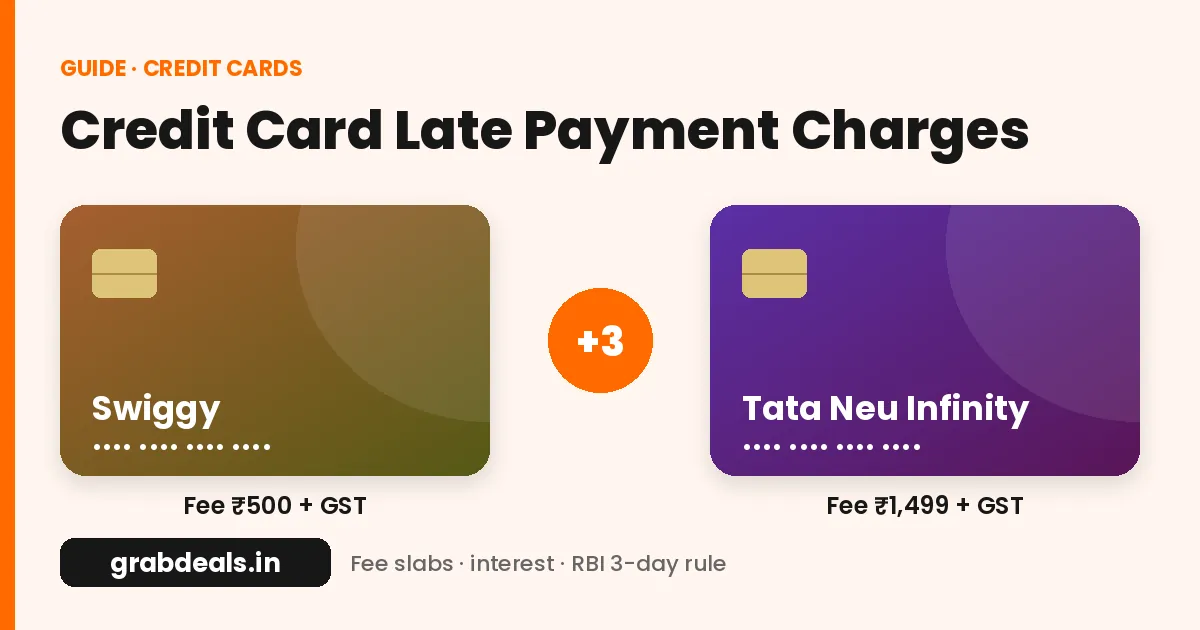
Missed a credit card bill by a few days and found a big charge on the next statement? You are not alone, and the good news is that credit card late payment charges in India follow clear, published rules. Each bank lists its late fee slabs in its Most Important Terms and Conditions (MITC), and the Reserve Bank of India decides when a late fee can be charged at all.
On 26 Nov 2026 we read the HDFC Bank credit card MITC (version 4.19, updated 24 Nov 2026), the YES BANK MITC (CMITC_V18_25112026), the BOBCARD Etihad Guest MITC and KFS, the Federal Bank Scapia card page, and the RBI Master Direction on credit cards with its FAQs. Every fee, rate and example below comes from those documents, linked at the end. We haven’t been issued these cards, and this is general information, not financial advice. New to how statements work? Start with our credit card billing cycle guide, or browse all cards on our credit cards page.
Quick answer
A credit card late payment charge is a flat fee your bank adds when you don’t pay at least the Minimum Amount Due by the payment due date. On HDFC Bank cards it ranges from nil (outstanding up to ₹100) to ₹1,300 (above ₹50,000); BOBCARD’s slabs also top out at ₹1,300; YES BANK charges 10% of the statement balance, capped at ₹1,350. GST at 18% is added, and you also lose the interest-free period, so interest of about 3.75% to 3.99% a month (45% to 47.88% a year on most cards) applies. RBI rules allow the late fee only when the card stays past due for more than three days. Pay the full amount by the due date and you pay none of it. Approval and terms are decided by each bank; this is information, not financial advice.
Swiggy HDFC Bank Credit Card
HDFC Bank
HDFC late payment charge runs from nil (balance up to ₹100) to ₹1,300 (above ₹50,000), plus GST, if the minimum due isn’t paid in time
- Joining fee
- ₹500 + GST
- Annual fee
- ₹500 + GST (waived on ₹2 lakh spend a year)
- Forex markup
- See HDFC MITC
Best for: Swiggy regulars. HDFC Bank is moving existing holders to Swiggy Ornge or BLCK in phases; HDFC Bank decides approval and terms.
Apply NowApproval, limit and final terms are decided by the bank.
Tata Neu Infinity HDFC Bank Credit Card
HDFC Bank × Tata Neu
Same HDFC late fee slabs and 3 grace days for payment processing; interest at 3.75% a month on most HDFC cards as per the MITC
- Joining fee
- ₹1,499 + GST
- Annual fee
- ₹1,499 + GST (waived on ₹3 lakh spend a year)
- Forex markup
- See HDFC MITC
Best for: Higher spenders on Tata brands. HDFC Bank decides approval and terms.
Apply NowApproval, limit and final terms are decided by the bank.
YES BANK POP-CLUB Credit Card
YES BANK
Late fee is 10% of the statement balance, capped at ₹1,350, and nil if the current outstanding is up to ₹500 (YES BANK MITC)
- Joining fee
- Nil
- Annual fee
- ₹399 + GST (waived on ₹1.5 lakh spend)
- Forex markup
- 3.5%
Best for: Online shoppers who want a nil joining fee. YES BANK decides approval and terms.
Apply NowApproval, limit and final terms are decided by the bank.
BOBCARD Etihad Guest Credit Card
BOBCARD (Bank of Baroda)
Late fee from ₹100 to ₹1,300 by statement balance; the card can be blocked if the minimum due is missed (BOBCARD MITC)
- Joining fee
- ₹2,500 + GST
- Annual fee
- ₹2,500 + GST (reversed on ₹3 lakh spend in a card year)
- Forex markup
- 1%
Best for: Etihad flyers who pay the full bill every month. BOBCARD decides approval and terms.
Apply NowApproval, limit and final terms are decided by the bank.
Federal Bank Scapia Credit Card
Federal Bank × Scapia
Zero joining and annual fee, but penal interest and charges apply if the bill isn’t paid by the due date; repay in the Scapia app
- Joining fee
- Zero
- Annual fee
- Zero
- Forex markup
- Zero
Best for: No-fee travel rewards card. Federal Bank decides approval and limit.
Apply NowApproval, limit and final terms are decided by the bank.
What counts as a late payment
A late payment is not about missing the full bill. Banks charge a late fee when you fail to pay at least the Minimum Amount Due (MAD) by the payment due date on your statement. HDFC Bank’s MITC says late payment charges apply if the MAD is not paid by the due date, and that clear funds need to be credited to the card account on or before that date. YES BANK’s MITC uses the same trigger: the fee is levied if the minimum amount due is not received by the payment due date, and it is charged in addition to the interest on the outstanding amount.
So there are really three outcomes each month:
- You pay the Total Amount Due on time: no late fee and no interest.
- You pay at least the MAD on time, but not the full bill: no late fee, but you lose the interest-free period and pay interest.
- You pay less than the MAD, or pay after the due date (and the grace days): late fee plus interest, plus GST on both.
The RBI 3-day rule and other protections
The RBI Master Direction on credit and debit cards says a bank can report your card as ‘past due’ to credit bureaus, or levy late payment charges, only when the account remains past due for more than three days. HDFC Bank’s MITC describes this as 3 grace days to cover payment processing time. YES BANK’s illustrations show the same pattern: a payment due date of 10 July with grace days up to 13 July.
The catch: the RBI also says the number of days past due and the late payment charges are counted from the original payment due date, not from the end of the grace days. The three days are a safety buffer for slow transfers, not an extra three days of free credit.
Two more rules worth knowing
- Late fee only on what is still unpaid: the RBI says late payment charges must be levied only on the outstanding amount after the due date, adjusted for payments and refunds, and not on the total amount due.
- No interest on unpaid charges: banks can’t capitalise unpaid charges, levies or taxes, which means they can’t charge interest on an unpaid late fee or its GST.
Late payment charges compared: HDFC, YES BANK, BOBCARD
Here are the slabs exactly as printed in each bank’s MITC (fees exclude GST). HDFC’s slab is based on the credit card bill amount (outstanding balance) and BOBCARD’s on the statement balance.
| Outstanding / statement balance | HDFC Bank | BOBCARD Etihad Guest |
|---|---|---|
| Up to ₹100 | Nil | ₹0 (less than ₹100) |
| ₹101 to ₹500 | ₹100 | ₹100 (₹100 to ₹500) |
| ₹501 to ₹1,000 | ₹500 | ₹400 |
| ₹1,001 to ₹5,000 | ₹600 | ₹750 (₹1,001 to ₹10,000) |
| ₹5,001 to ₹10,000 | ₹750 | ₹750 |
| ₹10,001 to ₹25,000 | ₹900 | ₹950 |
| ₹25,001 to ₹50,000 | ₹1,100 | ₹1,100 |
| Above ₹50,000 | ₹1,300 | ₹1,300 |
YES BANK works differently. If your current outstanding (statement balance plus unbilled spends) is up to ₹500, there is no late fee. Above ₹500, the fee is 10% of the statement balance or ₹1,350, whichever is lower, per statement. YES BANK says late payment charges are waived only for its YES Private card.
Federal Bank Scapia: the Scapia page on federal.bank.in says penal interest and charges may apply if payments are not received by the due date. The exact late fee slab is in Federal Bank’s Scapia MITC (version 12, dated 12 Nov 2026, linked from that page); we couldn’t open the document on 26 Nov 2026, so check it before relying on any number.
HDFC’s table excludes the Infinia (Metal Edition) card. The same HDFC MITC applies to the Swiggy HDFC, Tata Neu Plus HDFC and Tata Neu Infinity HDFC cards listed on GrabDeals.
Real examples from the bank documents
HDFC Bank: paid the minimum, but two days too late
In HDFC’s LPC illustration, the statement dated 1 May shows ₹25,000 due with a MAD of ₹1,250. The payment due date is 20 May and the grace date is 23 May. The cardholder spends another ₹5,000 after the statement and pays the ₹1,250 MAD on 25 May, after the grace date. Result: a late payment charge of ₹900, levied only on the ₹25,000 statement balance (the ₹10,001 to ₹25,000 slab), not on the ₹30,000 total outstanding.
YES BANK: the 10% rule and the ₹1,350 cap
YES BANK’s first illustration has a statement balance of ₹37,186.06 and a MAD of ₹2,884.27. Ten percent would be ₹3,718, so the cap applies and the late fee is ₹1,350. In the second, the statement balance is just ₹481, but ₹500 of new spends before the due date take the current outstanding to ₹981, above the ₹500 threshold. The fee is 10% of the statement balance: ₹48.10.
BOBCARD: a ₹1,000 bill left unpaid
BOBCARD’s MITC takes a single ₹1,000 purchase on 25 July, billed on 1 August with a ₹200 MAD and a 20 August due date. With no payment, the next statement carries finance charges of ₹46.85 (3.75% a month for 38 days), a late fee of ₹400 and GST of ₹80.43, so a ₹1,000 bill becomes ₹1,527.28 in a month. That is more than 50% extra for one missed payment.
The bigger cost: interest and GST
The late fee is only part of the bill. Once you miss the full payment, the interest-free period is gone and interest is charged from each transaction date. The monthly rates in the MITCs we read:
| Bank | Interest (most cards) | Extra notes from the MITC |
|---|---|---|
| HDFC Bank | 3.75% a month (45% a year) | 1.99% a month on Infinia, Diners Black and a few others; GST at 18% on interest and late payment charges |
| YES BANK | 3.99% a month (47.88% a year) | Lower rates for YES Private, Marquee, Reserv and some FD-backed cards |
| BOBCARD | 3.75% a month (45% a year) | Card may be blocked if the MAD isn’t paid by the due date |
The RBI FAQ says that if you don’t clear the total amount due, interest may be charged from the transaction date on the outstanding amount, adjusted for payments, and not on the total amount due. New purchases also attract interest until the old balance is fully cleared, as both HDFC and YES BANK explain.
Does a late payment hurt your credit score?
It can. Under the RBI rule, once the account is past due for more than three days the bank can report it to credit information companies. YES BANK’s MITC says that if you don’t pay at least the MAD by the due date plus grace days, the account is reported as ‘overdue’ in its monthly credit bureau submissions, and updated to ‘current’ in the next monthly refresh once you pay. BOBCARD’s MITC says that after you settle dues, it updates the bureaus within 30 days of settlement. A short, one-time delay you fix quickly is very different from months of missed payments, but it is better to avoid both.
How to avoid credit card late payment charges
- Set up auto-debit for at least the MAD, ideally the full amount. Note that a failed auto-debit can cost extra: HDFC charges 2% of the payment amount (minimum ₹450) for a returned payment or unsuccessful autopay, and BOBCARD 2% (minimum ₹500).
- Pay two or three working days early. HDFC says clear funds must reach the card account by the due date. Federal Bank’s Scapia page warns that repayments through third-party apps may delay bill clearance and recommends in-app repayment.
- Move your billing date to a few days after salary credit. The RBI lets you change your billing cycle at least once; our billing cycle guide explains how.
- Keep the outstanding small. On HDFC and BOBCARD cards a lower balance falls in a lower slab, and on YES BANK a current outstanding up to ₹500 carries no late fee.
- Track one due date. Fewer cards means fewer dates to remember. If a card isn’t worth its fee, read our annual fee waiver guide or look at lifetime free credit cards.
Already charged? What you can do
Pay at least the MAD right away so the account stops being past due, then check whether the fee was charged correctly under the 3-day rule and on the right slab. If you think it is wrong, raise it with customer care; the MITCs list the dispute and grievance contacts. A goodwill reversal of a correct fee is entirely the bank’s decision, so don’t count on it.
Card by card: late payment rules on GrabDeals cards
Swiggy HDFC, Tata Neu Plus HDFC and Tata Neu Infinity HDFC
All three follow the HDFC MITC: late payment charges from nil to ₹1,300 plus GST if the MAD isn’t paid by the due date, 3 grace days for processing, and interest at 3.75% a month (45% a year) when you revolve. Swiggy HDFC costs ₹500 a year (waived on ₹2 lakh spend) and Tata Neu Infinity ₹1,499 (waived on ₹3 lakh spend). Comparing the Tata Neu pair? See Tata Neu Plus vs Infinity.
YES BANK POP-CLUB
Nil joining fee and ₹399 annual fee (waived on ₹1.5 lakh spend). Late fee 10% of the statement balance up to ₹1,350, nothing if the current outstanding is ₹500 or less, and interest at 3.99% a month. More in our POP-CLUB guide.
BOBCARD Etihad Guest
₹2,500 + GST joining and annual fee, with the annual fee reversed on ₹3 lakh spend in a card year. Late fee from ₹100 to ₹1,300, interest at 3.75% a month, and the card may be blocked until the minimum due is paid.
Federal Bank Scapia
Zero joining and annual fee and zero forex mark-up, per Federal Bank’s Scapia page, with instant in-app repayment. Cash, DD or cheque payments aren’t accepted, and penal interest and charges may apply after the due date. See our Scapia card guide.
Frequently asked questions
What are the late payment charges on an HDFC credit card?
As per HDFC Bank’s MITC, the late payment charge depends on the outstanding balance: nil up to ₹100, ₹100 for ₹101 to ₹500, ₹500 for ₹501 to ₹1,000, ₹600 for ₹1,001 to ₹5,000, ₹750 for ₹5,001 to ₹10,000, ₹900 for ₹10,001 to ₹25,000, ₹1,100 for ₹25,001 to ₹50,000 and ₹1,300 above ₹50,000, plus GST.
Is there a grace period for credit card late payment?
RBI rules allow a late fee or past-due reporting only when the card stays past due for more than three days. HDFC calls these 3 grace days for payment processing. Days past due and late fees are still counted from the original due date.
Will I pay a late fee if I pay the minimum amount due on time?
No. Late payment charges apply when at least the Minimum Amount Due isn’t paid by the due date. But paying only the minimum means you lose the interest-free period and pay interest on the unpaid balance.
Is GST charged on credit card late fees?
Yes. HDFC Bank’s MITC illustrations add GST at 18% on interest and late payment charges, and BOBCARD’s example also adds GST on the finance charges and the late fee.
Can late payment charges be more than my bill?
The fee is a flat slab, so on a small bill it can be a large share. In BOBCARD’s example, an unpaid ₹1,000 bill picks up a ₹400 late fee, ₹46.85 interest and ₹80.43 GST in one month.
Sources (official pages, read 26 Nov 2026)
- Reserve Bank of India: Master Direction – Credit Card and Debit Card – Issuance and Conduct Directions, 2022 and FAQs (3-day past-due rule, late fee only on outstanding after due date, no capitalisation of charges; read 26 Nov 2026)
- HDFC Bank: Credit Card KFS cum MITC, version 4.19, updated 24 Nov 2026 (late payment charge slabs, 3 grace days, LPC illustration, 3.75% interest, GST, payment return charges, Swiggy and Tata Neu fees; read 26 Nov 2026)
- YES BANK: Credit Card MITC CMITC_V18_25112026 (10% / ₹1,350 late fee, ₹500 threshold, illustrations, 3.99% interest, POP-CLUB fees and 3.5% forex, bureau reporting; read 26 Nov 2026)
- BOBCARD: Etihad Guest MITC and KFS (late fee slabs, 3.75% interest, ₹1,000 example, fees, 1% forex, card blocking; read 26 Nov 2026)
- Federal Bank: Scapia Federal Credit Card page (zero fees, zero forex, in-app repayment, penal interest and charges after due date, link to MITC v12 dated 12 Nov 2026; read 26 Nov 2026)
Info checked 26 Nov 2026, 4:10 pm IST. Every fee, reward rate, welcome benefit and eligibility rule on this page was read from the bank’s own website and documents (listed under Sources) at that time. Banks change card terms often, so the bank’s page when you apply is final. Card approval, credit limit and final terms are decided only by the bank. Nothing here is financial advice or a guarantee of approval or savings.
Disclosure
Some buttons on this page (like “Apply Now”) take you to a partner site through our partner network, Cuelinks. If you apply and the bank approves your card through them, GrabDeals may earn a small commission at no extra cost to you. It never decides what we write or which card we suggest. As an Amazon Associate I earn from qualifying purchases. How we earn · How we pick
Keep exploring
Coupons today · Compare credit cards · Flights & hotels · All buying guides