Hotel Booking Tips for India: How to Get a Better Room for Less
Ten practical hotel booking tips for Indian trips: pick the area first, compare the final price with GST, book refundable, use price match and read the rules.
These hotel booking tips are for anyone who has opened a booking app, seen the same hotel at three different prices and wondered which one is real. In India the room rate is only part of the story: taxes, breakfast, cancellation terms, location and the property’s own rules can turn a cheap-looking room into an expensive stay, or the other way round.
Below are ten habits that help you get a better room for less money on Indian trips, from a weekend in Jaipur to a week in Kerala. Tax and price-match facts come from official pages read today (sources at the end). When you’re ready, use our hotel search or the full travel page.
Quick answer
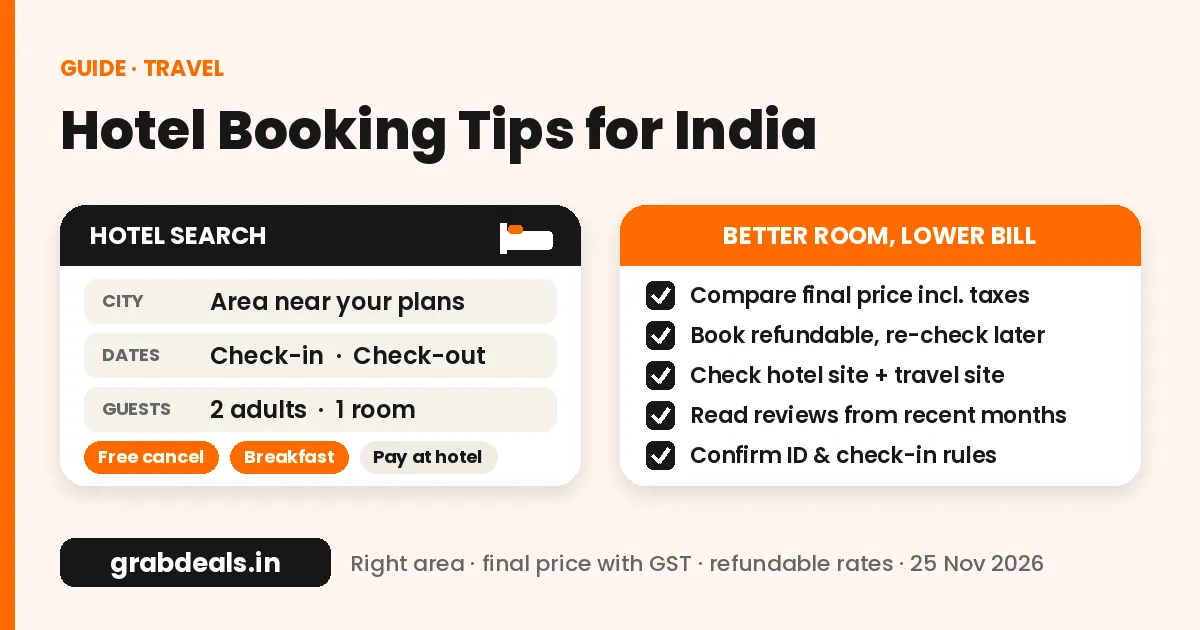
Fix the area first, then compare two or three hotels there on a travel site and on the hotel’s own website, always looking at the final price with taxes. Book a free-cancellation rate early and check again closer to the date; if the same room gets cheaper, rebook or use a price match where the site offers one. Before paying, read the cancellation rule, what’s included (breakfast or room only), the check-in time and the ID policy. Those are the hotel booking tips that save the most money and trouble. We don’t quote room rates because they change daily, so check current prices for your dates.
Hotel booking tips at a glance
The ten tips in one table. Each one is explained below.
| Tip | What it helps with |
|---|---|
| 1. Choose the area first | Saves cab money and travel time |
| 2. Compare the final price | Taxes and fees show up late |
| 3. Check two channels | Travel site vs hotel website |
| 4. Book refundable, then re-check | Lets you switch if prices fall |
| 5. Use price match where offered | Claim a difference without rebooking |
| 6. Pick the right rate type | Room only, breakfast, pay later |
| 7. Read recent reviews | Spot noise, cleanliness, hidden issues |
| 8. Check ID and timing rules | Avoid trouble at the front desk |
| 9. Be smart with dates | Weekdays and longer stays |
| 10. Stack offers carefully | Coupons and card offers, within terms |
1. Choose the area before the hotel
The cheapest room in the wrong part of town is rarely the cheapest trip. If you stay far from where you’ll spend your days, you pay for it in cabs, autos and time. So decide the base first: near the beach you want in Goa, walking distance to the Mall Road in Manali, close to the old city in Jaipur, or near the station or airport if you only need one night.
How to do it quickly
Open the map view on the booking site, mark the two or three places you’ll visit most and look only at hotels inside that circle. Then sort by price. You’ll usually find a decent option a little off the busiest street, which is often quieter too. Our Goa trip budget and Manali trip budget guides explain which areas suit which kind of trip.
2. Compare the final price, not the headline rate
Many listings show a per-night rate first and add taxes and fees on the last screen. Two hotels that look the same on the results page can end up quite different at checkout, so compare the amount you’ll actually pay for the whole stay.
GST on hotel rooms in India
Since 22 September 2025, GST on hotel accommodation valued at ₹7,500 or less per unit per day is 5% (it was 12% before), as per the GST Council recommendations published by PIB. The government’s FAQ on the 56th GST Council decisions also says this 5% rate is mandatory for such rooms. Rooms valued above ₹7,500 per night are not covered by the 5% slab, so check the tax line on the final screen for pricier rooms.
Also look for a separate convenience or service fee from the booking site and, at some resorts, mandatory charges such as a gala dinner on festival dates. These are set by the property or platform, so read the price breakup before you pay.
3. Check a travel site and the hotel’s own website
The same room can be priced differently on a travel site and on the hotel’s website. Travel sites are great for comparing many properties at once and sometimes carry coupon or bank offers. The hotel’s own site may have a member rate, a package with breakfast or a better cancellation rule. Many hotel chains run free loyalty programmes, so it can be worth signing up before you compare.
Our hotel search opens Trip.com with your city and dates filled in, and you can compare it with MakeMyTrip Hotels. For small guesthouses and homestays, a phone call or WhatsApp to the property can also help, especially for longer stays, but get the confirmation in writing.
4. Book a free-cancellation rate, then re-check
Hotel prices move with demand. If your plans are fairly fixed but you’re booking weeks ahead, a free-cancellation rate gives you room to manoeuvre. Book it, then check the same hotel and dates again a few days before the cancellation deadline. If the price has dropped, book the new rate first and then cancel the old one, so you never end up without a room.
Read the exact deadline
“Free cancellation” always comes with a cut-off date and time, usually in the hotel’s local time, and some rates charge the first night after that. Non-refundable rates are often cheaper, so they can make sense when your dates are certain, but you lose the money if plans change.
5. Use price match where a site offers one
Some booking sites refund the difference if you find the same room cheaper elsewhere. Trip.com, which powers our hotel search, runs a hotel price match. As per its official price-match page read today:
- The lower price must be for the same room type at the same property and the same dates, with the same breakfast policy, cancellation policy, number of guests and payment method.
- The lower price must be bookable on the property’s official website or one of Trip.com’s listed platforms, and available to all users, so prices using promo codes, loyalty points or card offers don’t count. Package prices don’t count either.
- You must submit proof by 11:59 PM (property’s local time) the day before check-in. Trip.com says it replies within 24 hours.
- The difference is refunded as Trip Coins, not cash, within 1 working day after you complete your stay. Cancelled bookings get nothing.
- The maximum refund is USD 1,500 per booking, one refund per booking, and the feature is in a trial phase in certain languages and regions only.
So price match is a useful backup, not a reason to skip comparing upfront.
6. Pick the right rate type
The same room often comes with several rates: room only, with breakfast, pay now, pay at hotel, refundable or non-refundable. Choose based on how you’ll actually travel.
Breakfast or room only?
If you’ll be out early for sightseeing, or the hotel is in a busy area full of cafés, room only can be the better value. In hill stations or resorts away from town, a breakfast-included rate is often simpler. Compare the difference with what breakfast would cost you outside.
Pay now or pay at hotel?
Pay-at-hotel or pay-later rates keep your money with you until the stay and can make cancellation simpler, but they may cost a little more than a prepaid rate. Check whether the property still needs a card to hold the booking.
7. Read recent reviews and real photos
Overall scores hide a lot. Read reviews from the last few months, sort by lowest score first and look for patterns: noise from a road or a bar, damp rooms in the monsoon, slow Wi-Fi, poor hot water in winter or a long walk from where the cab drops you. One bad review is luck; the same complaint five times is the hotel.
Look at guest photos as well as the hotel’s own pictures, and check the room size and bed type in the listing. If you need something specific, like a ground-floor room for elderly parents, request it in the booking notes and call the hotel to confirm.
8. Check ID, check-in time and house rules
Indian hotels normally ask every adult guest for a government photo ID at check-in, and some properties have their own rules on local IDs, unmarried couples or guests under a certain age. These rules are set by each property, so read the “house rules” or “property policies” section of the listing before you book, and call the hotel if anything is unclear.
Early check-in and late check-out
If your train or flight arrives early in the morning, check the hotel’s check-in time. Early check-in is usually subject to availability and may be charged. Sometimes booking the previous night costs less than paying for a guaranteed early check-in, and you get a proper rest. For flights, our guide to web check-in timings helps you plan the travel day.
9. Be smart with dates and length of stay
City business hotels can be busier on weekdays, while leisure spots near metros fill up on weekends, long weekends and festival weeks. If your dates are flexible, compare a Sunday-to-Thursday stay with a Friday-to-Sunday one. Some properties offer lower nightly rates for longer stays, so search the full stay in one go instead of night by night.
Last-minute hotel booking tips
Booking on the day can work in big cities with lots of hotels, but it’s risky during festivals, peak season in hill stations and beach towns, or when a big event is on. If you must book late, stick to well-reviewed properties, check the exact location again and confirm the booking with the hotel by phone.
10. Stack coupons and card offers, but read the terms
Booking sites often show coupon codes and bank card offers on the payment screen. Check the minimum booking value, the cap on the discount, whether it applies to hotels or only flights, and whether it works on pay-at-hotel rates. Card offers change often and are decided by the bank and the platform.
If you travel a lot, see our credit cards page and guides such as credit cards for lounge access and zero forex markup cards. Card approval and terms are always decided by the bank. Store-wise codes are on our coupons page.
A quick checklist before you pay
- The hotel is in the area you actually need.
- You’ve compared the total price, with taxes and fees, on at least two channels.
- You know the cancellation deadline and what you’d lose after it.
- The rate includes what you want (breakfast, number of guests, extra bed).
- You’ve read recent reviews and the property’s ID and house rules.
- The check-in time fits your arrival, or you’ve sorted early check-in.
- Any coupon or card offer is shown on the final payable amount.
- You’ve saved the confirmation and the hotel’s phone number.
Still deciding where to go? Try our weekend getaways from Delhi, from Mumbai or from Bangalore.
Book your stay
Search rooms on our hotel search, then compare with MakeMyTrip Hotels and the hotel’s own website before paying. Flying in? Use our flight search or Cleartrip. Room rates, taxes, fees and policies are set by the hotel or booking site and change often, so read the final price and the cancellation rule before you pay. We haven’t stayed at every property; the tips above are general advice plus facts from the official pages listed below.
Frequently asked questions
How can I book a hotel at a cheap price in India?
Choose the area first, compare the final price with taxes on a travel site and the hotel’s own website, book a free-cancellation rate early and re-check before the deadline, and use coupons or card offers only after reading their terms.
What is the GST on hotel rooms in India?
Since 22 September 2025, hotel accommodation valued at ₹7,500 or less per unit per day attracts 5% GST without input tax credit, as per the GST Council decisions published by PIB. For costlier rooms, check the tax line on the booking’s final screen.
Is it cheaper to book a hotel directly or through a booking site?
It depends on the hotel and the date. Travel sites may carry coupons or bank offers, while the hotel’s website may have member rates or better cancellation terms, so compare the final price on both before you book.
How does Trip.com hotel price match work?
If the same room, dates and conditions are cheaper on the property’s website or a listed platform, you can submit proof by 11:59 PM property time the day before check-in. Approved differences are refunded as Trip Coins after your stay, up to USD 1,500 per booking.
Should I book a refundable or non-refundable hotel room?
Book refundable if your plans may change or you want to re-check prices later. A non-refundable rate is often cheaper but you lose the money if you cancel, so pick it only when your dates are certain.
What ID is needed for hotel check-in in India?
Hotels usually ask every adult guest for a government photo ID, and some properties have their own rules on local IDs or couples. Read the property policies on the listing and call the hotel if unsure.
Sources (official pages, read 25 Nov 2026)
- PIB: 56th GST Council recommendations (hotel accommodation up to ₹7,500 per unit per day: GST cut from 12% to 5%, services from 22 Sep 2025)
- PIB: FAQs-2 on 56th GST Council decisions (5% without ITC is mandatory for rooms up to ₹7,500 per unit per day)
- PIB factsheet: GST reforms for hospitality (hotels below ₹7,500/day from 12% to 5% without ITC)
- Trip.com: Hotel price match terms (same room/conditions, deadline 11:59 PM day before check-in, Trip Coins, max USD 1,500, trial phase)
Info checked 25 Nov 2026, 4:05 pm IST. Facts on this page were read from the official pages listed under Sources at that time. Fares, hotel prices and rules change often, so the airline, hotel or booking site is final.
Disclosure
Some buttons on this page take you to a partner site through our partner network, Cuelinks. If you book or buy through them, GrabDeals may earn a small commission at no extra cost to you. It never decides what we write or which option we suggest. How we earn · How we pick
Keep exploring
Shop fashion · Coupons today · Compare credit cards · Flights & hotels · All buying guides